



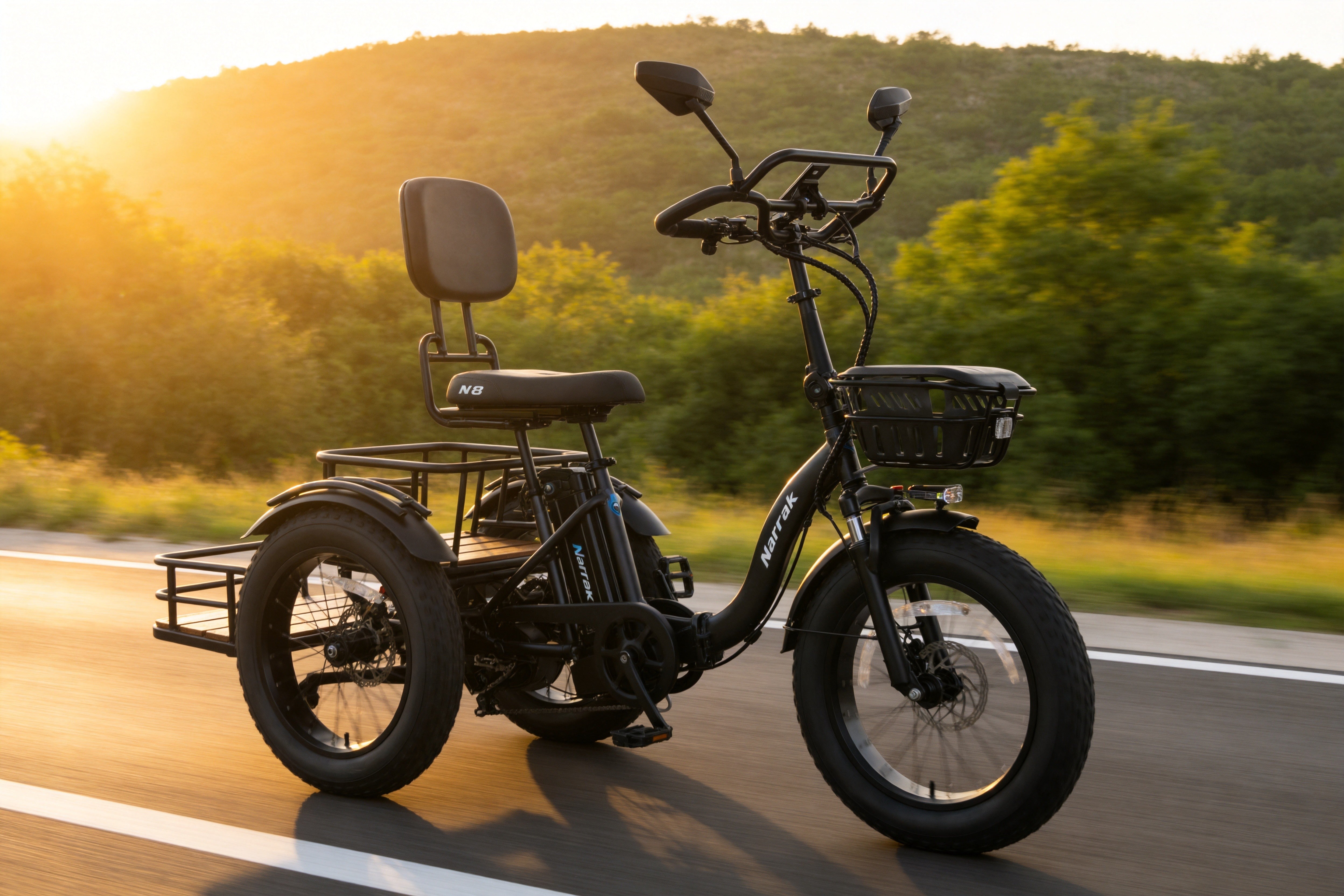
How fast do e-bikes go? It depends on the class: Class 1 and 2 e-bikes are limited to 20 MPH, Class 3 to 28 MPH, and off-road/motocross models can reach 30–50+ MPH. Motor wattage, rider weight, terrain, and battery charge all affect real-world speed. For example, the Narrak M3 reaches 28 MPH as a Class 3 e-bike at $669.
How Fast Do E-Bikes Go? Speed by Class
The U.S. uses a three-class system that defines the maximum motor-assisted speed for each category.
| Class | Max Assisted Speed | Throttle? | Typical Use |
|---|---|---|---|
| Class 1 | 20 MPH | No (pedal-assist only) | Commuting, bike paths |
| Class 2 | 20 MPH | Yes (throttle) | Commuting, casual riding |
| Class 3 | 28 MPH | Varies (pedal-assist or throttle to 20) | Fast commuting, trail riding |
| Off-road / Unclassified | 30–50+ MPH | Yes | Private land, motocross |
Speed by Motor Wattage: 250W to 2000W
Motor wattage affects acceleration and hill-climbing ability more than top speed. Here is the real-world relationship.
| Motor (Peak) | Flat-Ground Speed | Hill Climbing | Best For |
|---|---|---|---|
| 250W | 15–20 MPH | Struggles on steep hills | Flat commuting, light assist |
| 500W | 18–22 MPH | Moderate hills OK | Casual trail, hilly suburbs |
| 750W | 22–28 MPH | Handles most hills | Fast commuting, cargo hauling |
| 1100W (Narrak M3) | 25–28 MPH | Strong climbing | Off-road, steep grades, heavy riders |
| 1500W | 28–33 MPH | Powerful climbing | Off-road (may require registration) |
| 2000W | 30–38 MPH | Excellent climbing | Motocross (motorcycle classification) |
Speed by E-Bike Type
E-bike type affects speed as much as motor wattage. Tire width, frame weight, and geometry all play a role.
| E-Bike Type | Typical Top Speed | Why |
|---|---|---|
| Commuter / City | 20–28 MPH | Lightweight, narrow tires, efficient |
| Fat-Tire / Off-Road | 20–28 MPH | Wider tires = more rolling resistance, but stable at speed |
| Folding | 20–28 MPH | Small wheels limit top speed slightly |
| Electric Trike | 16–20 MPH | Heavier, wider stance, lower gearing |
| Moped-Style | 28–35 MPH | Motorcycle geometry, high power |
| Electric Dirt Bike | 20–50+ MPH | Wide range—e-bikes vs. motorcycles |
Rider Weight & Hill Climbing Speed
Rider weight is the single biggest factor most speed charts ignore. Heavier riders climb slower and use more battery per mile.
| Rider Weight | 10% Grade Climbing (1100W) | Flat Ground Speed (1100W) | Battery Consumption |
|---|---|---|---|
| 130 lbs (59 kg) | 14–16 MPH | 26–28 MPH | ~15 Wh/mile |
| 170 lbs (77 kg) | 12–14 MPH | 25–28 MPH | ~18 Wh/mile |
| 200 lbs (91 kg) | 10–12 MPH | 24–27 MPH | ~22 Wh/mile |
| 230 lbs (104 kg) | 8–10 MPH | 23–26 MPH | ~26 Wh/mile |
| 260 lbs (118 kg) | 7–9 MPH | 22–25 MPH | ~30 Wh/mile |
Narrak Model Speed Comparison
Every Narrak model with real-world top speed data, so you can pick the right speed for your riding style.
| Model | Type | Peak Power | Tires | Top Speed | Price |
|---|---|---|---|---|---|
| N3 | Electric Trike | 700W | 18×3.0" | 16 MPH | $620 |
| N6 | Electric Trike | 1100W | 18×3.0" | 20 MPH | $689 |
| M301 | Mountain E-Bike | 540W | 26×2.125" | 20 MPH | $359 |
| S127 | Folding Fat-Tire | 1100W | 20×4.0" | 28 MPH | $630 |
| S129 | Folding Fat-Tire (Step-Through) | 1100W | 20×4.0" | 28 MPH | $640 |
| M3 | Mountain E-Bike (Moto Stance) | 1100W | 16×4.0" | 28 MPH | $669 |
| S180 | Electric Trike | 1350W | 20×4.0" | 20 MPH | $1,099 |
| N8 | Electric Trike | 750W | 20×4.0" | 20 MPH | $1,399 |
What Actually Limits E-Bike Speed? The Physics
Understanding what caps your speed helps you make smarter buying decisions.
1. Motor Controller Limit
The controller is the brain that limits how much power reaches the motor. Class 1/2 controllers cut assist at 20 MPH; Class 3 at 28 MPH. This is a software limit, not a mechanical one.
2. Wind Resistance (The Big One)
Air drag increases with the square of speed. Going from 20 MPH to 28 MPH requires about 96% more power just to overcome wind. This is why a 28 MPH e-bike needs 1100W while a 20 MPH model needs only 750W.
3. Battery Voltage
Higher voltage pushes more current through the motor. A 48V system is standard for 750W–1100W motors. A 52V system gives ~8% more speed than 48V at the same wattage.
4. Tire Width and Pressure
Fat tires (4.0") create more rolling resistance than narrow tires (2.1"), reducing top speed by 1–3 MPH at the same power. However, fat tires provide stability and traction that let you safely use the available speed on loose terrain.
5. Rider Weight and Cargo
Every additional 50 lbs of rider/cargo weight reduces hill-climbing speed by ~2–3 MPH and flat-ground speed by ~1 MPH. It also increases battery consumption by 15–20%.
How fast does a 1000W e-bike go?
A 1000W e-bike typically reaches 25-28 MPH on flat ground with a 170 lb rider. The Narrak M3 with 1100W peak reaches 28 MPH as a Class 3 e-bike.
Can an e-bike go 30 MPH?
Class 3 e-bikes are limited to 28 MPH motor-assisted speed. You can exceed 28 MPH by coasting downhill or pedaling harder. For sustained 30+ MPH, you need an off-road or unclassified e-bike.
Does rider weight affect e-bike speed?
Yes, significantly. A 230 lb rider will climb hills 3-5 MPH slower than a 130 lb rider on the same e-bike, and use 60-70% more battery per mile.
Are fat tire e-bikes slower than regular e-bikes?
Slightly. Fat tires create more rolling resistance, reducing top speed by 1-3 MPH. The trade-off is better traction and stability on loose terrain.
How fast do electric trikes go?
Most electric trikes reach 16-20 MPH. The Narrak N3 reaches 16 MPH ($620), while the N6 with 1100W reaches 20 MPH ($689). Trikes prioritize stability over speed.
What is the fastest street-legal e-bike?
In the U.S., Class 3 e-bikes are limited to 28 MPH. The Narrak M3, S127, and S129 all reach 28 MPH as Class 3 e-bikes.
Conclusion
How fast do e-bikes go? The answer depends on class (20 or 28 MPH for street-legal models), motor wattage (more power helps hills more than flat speed), rider weight (heavier = slower), and terrain. For most riders, a 28 MPH Class 3 e-bike like the Narrak M3 at $669 with 1100W peak and fat tires offers the best speed-to-value ratio in 2026. Faster options exist, but they come with motorcycle regulations.
Find the right speed for your ride and add to cart.
Shop All E-Bikes →
Share:
Electric Trike for Seniors Guide (2026) | Narrak
Fat Tire Electric Bike 2000W Guide: Power, Range & What to Know