



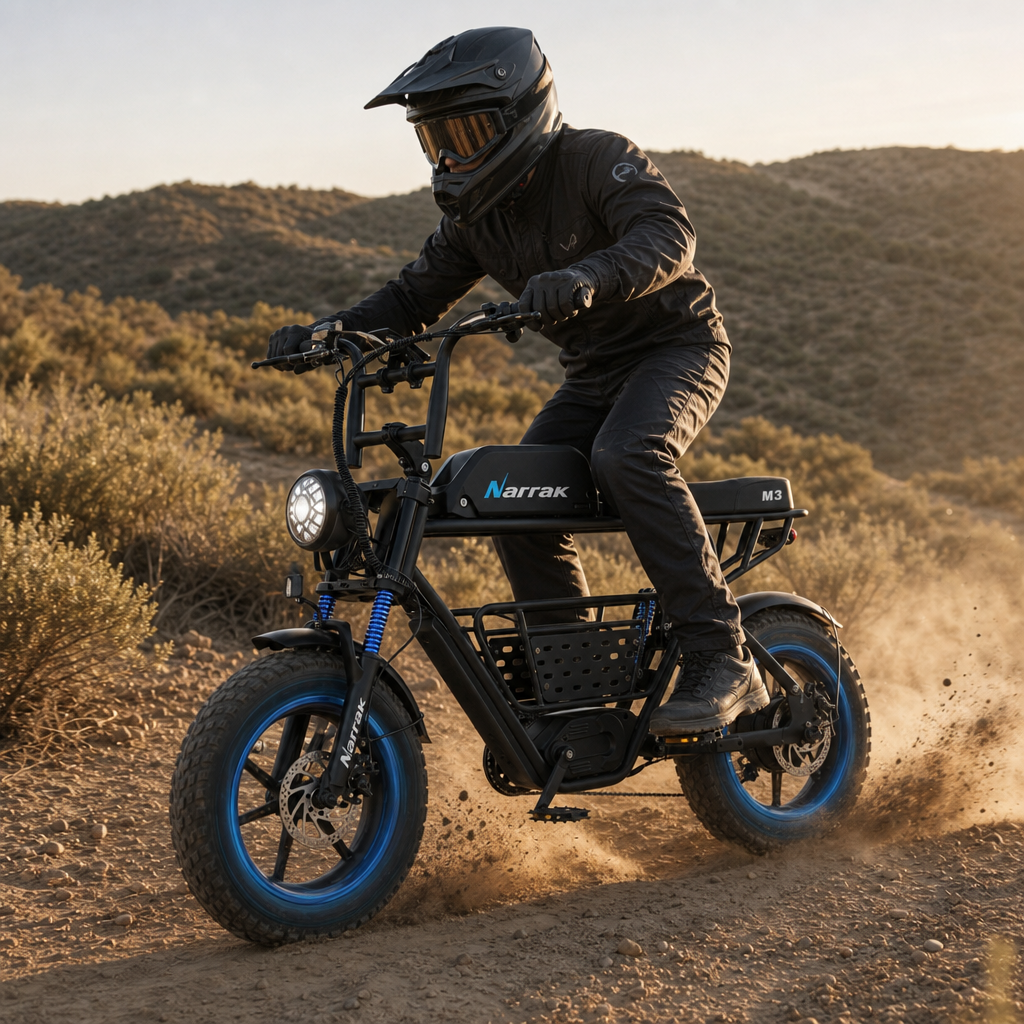
The best off road electric bike for most riders in 2026 is the Narrak S127 at $630—a folding fat-tire ebike with 1100W peak, 20×4.0" tires, and enough range for gravel loops and fire roads. For 28 MPH dirt-style power and dual suspension, the Narrak M3 at $669 is the top pick. Need three-wheel stability on loose gravel? The folding Narrak S180 at $1,099 adds a hydraulic differential for confident off-road cornering.
What Is an Off-Road Electric Bike?
An off-road electric bike is a pedal-assist ebike built for unpaved surfaces—gravel roads, fire trails, hardpack dirt, and rough pavement—with fat tires, 1000W+ peak power, and trail-ready geometry, not a gas-powered motocross machine.
When shoppers search for an off road electric bike, they usually want one of three things:
- Capable fat-tire ebike — wide tires, front or dual suspension, and enough torque for gravel paths, fire roads, and unpaved parks
- Dirt-bike-inspired frame — motorcycle-style styling with pedals, battery, and bicycle legal status on mixed street-and-trail routes
- Three-wheel stability — a fat-tire electric trike for riders who prioritize balance on loose surfaces over two-wheel agility
All three are electric bicycles under US federal law—not gas dirt bikes. That means no fuel, no registration in most states, and no motorcycle license. You pedal (or throttle on Class 2 models), charge from a wall outlet, and ride trails where local ebike rules allow.
Off-road ebikes excel where standard commuters fail: loose gravel, washboard fire roads, hardpack singletrack, and unpaved multi-use paths. They won't replace a $5,000 full-suspension mountain bike on technical singletrack—but they handle the terrain most riders actually encounter on weekend loops and mixed-commute days.
Off-Road Terrain Types & What You Need
Match tire width, suspension, and frame type to the surfaces you actually ride—gravel and fire roads need different hardware than soft sand or steep hardpack.
1. Gravel Roads & Fire Roads
The most common off-road surface for ebike riders. Loose gravel and compacted dirt demand 20×4.0" fat tires at 12–18 PSI for flotation and grip. A 1100W peak hub motor handles moderate grades; front suspension (S127, S129) or dual suspension (M3) absorbs washboard chatter. Any Narrak pick in this guide handles gravel confidently.
2. Hardpack Dirt & Packed Trails
Firm, dry singletrack and park paths reward responsive handling over maximum suspension travel. Folding folders (S127/S129) are nimble on hardpack; the M3's lower 16×4.0" stance and dual suspension soak up roots and ruts. Lower tire pressure (14–16 PSI) improves cornering grip without sacrificing speed on firm surfaces.
3. Soft Dirt, Sand & Loose Surfaces
Soft surfaces punish narrow tires and underpowered motors. You need 4.0" minimum tire width, 1000W+ peak output, and realistic speed expectations—throttle-heavy riding on sand cuts range by 30–40%. For riders who struggle with balance on loose gravel, a three-wheel platform like the S180 folding trike with hydraulic differential prevents tip-overs without sacrificing fat-tire grip.
4. Mixed Pavement + Trail Days
Commute on asphalt, explore gravel on weekends? A folding fat-tire folder (S127/S129) transitions between both—folds for car trunks and RV bays, rolls efficiently on pavement at 28 MPH pedal assist, and handles fire roads without a second bike. Dirt-style frames (M3) prioritize street speed and moto aesthetics over trunk portability.
5. Steep Grades & Loaded Climbs
Hills with cargo or rider weight above 220 lbs demand peak power, not just rated watts. Look for 1100W+ peak (S127, S129, M3) or 1350W peak on the S180 trike. Mid-drive motors excel on extreme grades, but hub motors at this price deliver enough torque for fire-road inclines and suburban hills.
What to Look for in an Off-Road Electric Bike
Prioritize fat tire width, peak motor power, suspension type, battery capacity with UL certification, and realistic range—the five specs that separate a trail-capable off-roader from a styled commuter.
1. Fat Tires: 4.0" Minimum
Narrow road tires sink and slip on dirt. Off-road electric bikes need 20×4.0" or 16×4.0" fat tires for flotation and grip. The S127 and S129 use 20×4.0"; the M3 uses 16×4.0" for a lower, moto-style stance; the S180 trike rolls on 20×4.0" fat tires on all three wheels.
2. Peak Power: 1000W+ (Not Just Rated Watts)
Rated motor watts understate hill and trail performance. Look for 1000W+ peak output. The S127, S129, and M3 deliver 1100W peak from 750W-rated hub motors. The S180 pushes 1350W peak for loaded climbs and loose-surface acceleration.
3. Suspension: Front vs. Dual vs. Rigid Trike
- Front fork only (S127/S129) — enough for gravel and fire roads; lighter and lower cost
- Dual suspension (M3) — front fork plus rear shock for potholes, curb drops, and washboard gravel
- Trike platform (S180) — three contact points replace rear suspension; hydraulic differential handles cornering loads on uneven paths
4. Battery: 48V 13Ah + UL Certification
Minimum for real trail range: 48V 10Ah. Better value: 48V 13Ah (624Wh) removable packs on S127, S129, and M3. Confirm UL 2271 (battery) and UL 2849 (complete ebike)—non-negotiable for safe charging at home, especially when trail riding stresses the system harder than pavement commuting.
5. Range Expectations Off-Road
Manufacturer range ratings assume pavement and moderate assist. Off-road riding with soft surfaces, hills, and throttle use reduces range by 20–40%. Plan for 35–50 miles on trail-heavy days with the S127/S129 (55–65 mi rated), and 30–40 miles with the M3 (50 mi rated). The S180 trike rates similarly depending on terrain and load.
Folder vs. Dirt-Style vs. Trike: Which Off-Road Frame Fits You?
Frame type is the biggest fork in the road for off-road ebike buyers—choose based on storage, balance, and the terrain you ride most, not looks alone.
Folding Fat-Tire Folder (S127 / S129)
Best for: Mixed commute + trail days, RV travel, apartment storage, riders who need trunk-friendly portability.
- Collapses for SUV trunks and RV bays—no bike rack required
- 20×4.0" fat tires float over gravel and hardpack
- Step-over (S127) or step-through (S129) mount options
- Front suspension handles fire roads; lighter to maneuver than a trike
Choose a folder if you split time between pavement and gravel, or if fold-down storage is non-negotiable. The S129 adds a step-through frame for easier mounting without changing the power platform.
Dirt-Style Rigid Frame (M3)
Best for: Urban speed on rough streets, aggressive styling, riders who want 28 MPH and dual suspension without foldability.
- Motorcycle-inspired tubing and moto geometry
- Dual suspension absorbs potholes, curb drops, and washboard gravel
- 16×4.0" fat tires for a lower, aggressive stance
- Class 3-capable at 28 MPH pedal assist
Choose dirt-style if top speed, full suspension, and moto aesthetics matter more than folding into a trunk. For styling comparisons, see our moped style ebike guide.
Folding Electric Trike (S180)
Best for: Riders who prioritize balance on loose gravel, cargo stability, and confident cornering on uneven off-road paths.
- Three-wheel platform eliminates tip-over risk on soft surfaces
- Rear hydraulic differential lets each wheel spin at different speeds through corners—rare under $1,500
- 1350W peak for loaded climbs with groceries or gear
- Folds for storage despite the three-wheel footprint
Choose a trike if two-wheel balance on loose gravel is a concern, or if you haul cargo on unpaved routes. Read the full breakdown in our folding electric trike guide.
Best Off-Road Electric Bikes (2026)
Four Narrak models cover the off-road spectrum—from sub-$700 folding folders to a hydraulic-differential trike for loose-gravel stability.
Trail-Ready Picks
- Narrak S127 — $630 — Best off-road folder; 1100W peak, 20×4.0" fat tires, folding frame, 55–65 mi range
- Narrak S129 — $640 — S127's step-through sibling; same power platform, easier mount for shorter riders
- Narrak M3 — $669 — Best dirt-style off-roader; 28 MPH, dual suspension, 16×4.0" fat tires
- Narrak S180 — $1,099 — Best trike for off-road stability; 1350W peak, hydraulic differential, 20×4.0" fat tires on all three wheels
All models ship from Los Angeles with free LA-area shipping, 30-day returns, and a 1-year warranty. Browse the full lineup on the fat-tire off-road ebike collection for specs side by side.
Best Off-Road Folder: Narrak S127
The S127 is the value king for riders who want fat-tire off-road capability and a folding frame under $650—1100W peak, 20×4.0" tires, and trunk-friendly portability for gravel loops and fire roads.
Narrak S127 Folding Fat-Tire Ebike
| Peak Motor | 1100W (750W rated) |
| Battery | 48V 13AH (624Wh) · Removable · UL 2271 |
| Top Speed | Up to 28 MPH (pedal assist) |
| Max Range | 55–65 miles |
| Tires | 20" × 4.0" fat |
| Frame | Folding · Step-over |
| Suspension | Front fork |
| Brakes | Dual disc with motor cutoff |
| Display | M5 large LCD |
| Rider Capacity | Up to 290 lbs |
| Certifications | UL 2849 / UL 2271 · IPX5 |
| Price | $630 |
The S127 folds down for SUV trunks, RV bays, and apartment storage—something no rigid dirt-style frame can match. Its 20×4.0" fat tires float over gravel and hardpack, while the 1100W peak hub motor handles moderate hills and fire-road grades without bogging down. A removable UL-certified battery lets you charge indoors after muddy trail days.
Choose the S127 if you split time between pavement commutes and weekend gravel loops, or if you need a folding off-road ebike that handles fire roads and fits in a car trunk. Pair it with the step-through S129 ($640) if mounting height matters.
✔ Verdict: Best off-road electric bike for portability—real fat-tire trail hardware at the lowest price in Narrak's lineup.
Shop S127 →Best Dirt-Style Off-Roader: Narrak M3
The M3 trades foldability for motorcycle-inspired geometry, dual suspension, and 28 MPH Class 3 speed—the best dirt-style off-road electric bike under $700.
Narrak M3 Dirt E-Bike
| Peak Motor | 1100W (750W rated) |
| Battery | 48V 13AH (624Wh) · Removable · UL 2271 |
| Top Speed | 28 MPH |
| Max Range | Up to 50 miles |
| Tires | 16" × 4.0" fat |
| Frame | Dirt-bike-inspired · Rigid moto geometry |
| Suspension | Dual (front fork + rear shock) |
| Brakes | Dual disc with motor cutoff |
| Gears | Shimano 7-speed |
| Rider Capacity | 290 lbs (5'3" – 6'5") |
| Certifications | UL 2849 / UL 2271 · IPX5 |
| Price | $669 |
The M3 looks and rides like a mini dirt bike—but it's still a pedal-assist ebike with UL certification. Dual suspension absorbs potholes, curb drops, and washboard gravel that would rattle a hardtail folder. The transmission-boosted motor delivers 1100W peak on acceleration and climbs.
Choose the M3 if you want 28 MPH dirt-style power with dual suspension for gravel and rough pavement and don't need to fold the bike into a trunk. Its lower 16×4.0" stance improves stability on hardpack and urban off-road routes.
✔ Verdict: Best dirt-style off-road pick for riders who want 28 MPH speed, full suspension, and aggressive trail aesthetics under $700.
Shop M3 →Three-Wheel Off-Road Stability: Narrak S180
The S180 is Narrak's folding electric trike for riders who need three-wheel balance and hydraulic differential cornering on loose gravel—1350W peak and 20×4.0" fat tires on every wheel.
Two-wheel off-road ebikes demand balance on soft surfaces. The Narrak S180 at $1,099 solves that with a stable three-wheel platform, 1350W peak motor, and a rear hydraulic differential that lets each rear wheel spin at different speeds through corners—reducing tire scrub and improving control on uneven gravel paths.
Key off-road advantages over two-wheel folders:
- No tip-over risk on loose gravel, soft dirt, or low-speed maneuvers with cargo loaded
- 20×4.0" fat tires on all three wheels — maximum flotation on fire roads and unpaved paths
- Hydraulic differential — rare under $1,500; improves cornering stability where standard trike axles scrub tires
- 1350W peak — more torque for loaded climbs on graded fire roads
- Folding frame — still collapses for garage or RV storage despite the three-wheel footprint
The S180 isn't a motocross machine—it excels on gravel roads, hardpack trails, and unpaved multi-use paths where balance and loaded stability matter more than aggressive singletrack handling. For a deep dive on trike specs and differential technology, see our folding electric trike guide.
Off-Road Electric Bike Comparison Table
Folder, dirt-style, or trike? Use this table to match frame type, power, and price to the off-road terrain you actually ride.
| Model | Price | Peak Power | Top Speed | Tires | Frame | Suspension | Range | Best Off-Road For |
|---|---|---|---|---|---|---|---|---|
| S127 ★ | $630 | 1100W | 28 MPH | 20×4.0" | Folding · 2-wheel | Front | 55–65 mi | Best value folder + gravel |
| S129 | $640 | 1100W | 28 MPH | 20×4.0" | Folding · Step-through | Front | 55–65 mi | Easier mount, same trails |
| M3 | $669 | 1100W | 28 MPH | 16×4.0" | Dirt-style · 2-wheel | Dual | Up to 50 mi | 28 MPH + washboard gravel |
| S180 | $1,099 | 1350W | 20 MPH | 20×4.0" ×3 | Folding · 3-wheel | Hydraulic diff | Varies by terrain | Loose gravel stability + cargo |
Choose S127 or S129 if you need fold-down storage, RV travel, or a lighter off-road commuter for gravel and fire roads. Choose M3 if top speed, dual suspension, and dirt-bike looks matter more than portability. Choose S180 if three-wheel balance and hydraulic differential cornering on loose surfaces are priorities. All models carry UL 2849 / UL 2271 certification.
Safety & Trail Access for Off-Road Ebikes
Off-road electric bikes are street-legal bicycles in most US states—Class 2 or Class 3 rules apply on roads, and motorized trail access varies by park and land manager.
Class 2 vs. Class 3 (Quick Reference)
- Class 2: Pedal assist + throttle up to 20 MPH — broadest access on bike paths and greenways
- Class 3: Pedal assist up to 28 MPH (throttle typically limited to 20 MPH) — faster on streets; some paths restrict Class 3
- Federal baseline: Operational pedals + motor ≤750W rated = bicycle, not motor vehicle — no motorcycle license in most states
Trail & Off-Road Access
Not every dirt path allows ebikes. National and state parks, BLM land, and local trail systems each set their own rules—some permit Class 1/2 ebikes, others ban all motorized bikes. Always check posted signs and land-manager websites before riding off-road. Off-road ebikes excel on gravel roads, fire roads, and unpaved multi-use paths where ebikes are explicitly allowed.
Off-Road Riding Gear
- Helmet — required or strongly recommended in most states; essential on loose gravel and hardpack
- Gloves and eye protection — gravel spray and branch strikes happen fast on fire roads
- Front and rear lights — included on S127, S129, M3, and S180; use them at dusk on unpaved paths
- Lower tire pressure on dirt — 12–18 PSI on 4.0" tires improves grip on gravel and soft surfaces (check sidewall max)
Off-Road Electric Bike Buying Checklist
Run through these seven checks before checkout—they prevent the two most common off-road buyer mistakes: choosing a styled commuter that can't handle dirt, or picking the wrong frame type for your terrain.
- Match frame type to terrain. Gravel + trunk storage? → S127 or S129. Speed + dual suspension on rough streets? → M3. Loose gravel balance + cargo? → S180 trike.
- Confirm peak power ≥1000W. Rated 750W with 1100W peak handles fire-road grades; S180's 1350W peak covers loaded climbs.
- Verify tire width ≥4.0". Skinnier tires slip on gravel and sink in soft dirt—non-negotiable for off-road.
- Check UL 2849 + UL 2271. Non-certified batteries are a safety risk on trail-stressed systems—not a place to save $50.
- Plan range for off-road conditions. Cut rated range by 20–40% for hills, soft surfaces, and throttle-heavy riding.
- Match speed class to your routes. Class 3 (28 MPH) for street speed to trailheads; Class 2 (20 MPH) if you rely on restricted bike paths.
- Confirm US support. Narrak ships from Los Angeles with free LA shipping, 30-day returns, 1-year warranty, and phone support at +1 (626) 328-6000.
Ready to compare models? Start with the fat-tire off-road ebikes built for gravel paths, fire roads, and unpaved trails—all current Narrak off-road picks in one place.
FAQ: Off-Road Electric Bikes
Six common questions on terrain, frame type, range, and how off-road electric bikes compare to gas dirt bikes.
What is the best off-road electric bike in 2026?
The Narrak S127 at $630 is the best off-road electric bike for most riders—1100W peak, 20×4.0" fat tires, folding frame, and 55–65 mile range on gravel and fire roads. For dirt-style dual suspension and 28 MPH speed, the M3 at $669 is the top alternative. For three-wheel stability on loose surfaces, the S180 at $1,099 adds a hydraulic differential.
Can off-road electric bikes handle gravel and fire roads?
Yes—off-road electric bikes with 4.0" fat tires and 1100W+ peak power handle gravel roads, fire roads, and hardpack trails confidently. Lower tire pressure (12–18 PSI) improves grip on loose surfaces. They aren't built for technical mountain-bike singletrack, but they excel on the unpaved paths most riders use for weekend loops.
Should I choose a folding folder, dirt-style frame, or trike for off-road?
Choose a folding folder (S127 or S129) for mixed commute + trail days and trunk storage. Choose a dirt-style frame (M3) for 28 MPH speed and dual suspension on rough streets and washboard gravel. Choose a trike (S180) for three-wheel balance, cargo stability, and hydraulic differential cornering on loose off-road surfaces.
Are off-road electric bikes street legal?
Yes in most US states—as Class 2 or Class 3 ebikes they require no motorcycle license or registration on public roads. Class 3 models (28 MPH pedal assist) may be restricted on some bike paths. Off-road trail access varies by land manager—always verify local rules before riding on unpaved paths in parks or conservation areas.
What range can I expect from an off-road electric bike?
Expect 35–50 miles on trail-heavy days depending on model, rider weight, and terrain. The S127 and S129 rate 55–65 miles on pavement; the M3 delivers up to 50 miles. Off-road riding with soft surfaces, hills, and throttle use reduces range by 20–40%—plan accordingly for fire-road loops.
Off-road electric bike vs gas dirt bike: what's the difference?
Off-road electric bikes have pedals, rechargeable batteries, and bicycle legal status—no fuel, no registration in most states, and access to many multi-use paths where gas bikes are banned. Gas dirt bikes are motor vehicles with engines, exhaust, and DMV requirements starting around $2,500+. Electric off-road ebikes are quieter, cheaper to run, and better suited for mixed street-and-gravel riding.
Conclusion
An off road electric bike in 2026 comes down to three decisions: terrain (gravel, hardpack, or loose surfaces), frame type (folder, dirt-style, or trike), and peak power + fat tires (1100W+ and 4.0" minimum).
For most riders, the Narrak S127 at $630 delivers the best off-road value with a folding fat-tire platform for gravel and fire roads. Need 28 MPH and dual suspension? The M3 at $669 closes the gap. Need three-wheel stability on loose gravel? The S180 at $1,099 adds hydraulic differential cornering. All models ship with UL certification, free LA shipping, 30-day returns, and a 1-year warranty.
Free shipping from Los Angeles · 30-day returns · 1-year warranty · UL 2849 / UL 2271 certified
Shop Off-Road Ebikes →
Share:
Class 2 vs Class 3 Ebike Explained
Electric Trikes for Adults: Cargo, Commute & Daily Use (2026)