



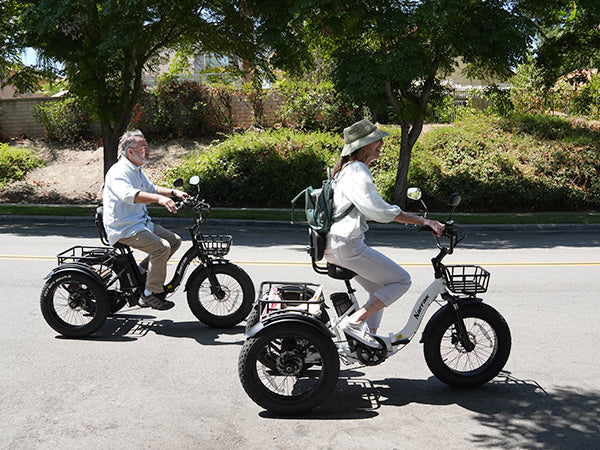
Yes—electric trikes are generally safe for seniors when you choose the right features: three-wheel stability, hydraulic brakes, anti-tip wheels, UL-certified batteries, parking brake, and a Class 2 speed cap of 20 MPH. The safest picks in 2026 are the Narrak N8 (triple hydraulic + anti-tip) and S180 (hydraulic differential + foldable).
Why Electric Trikes Are Safer Than Two-Wheel Ebikes for Seniors
Three wheels eliminate the balance problem that causes most senior cycling falls—you stay upright at stops, slow speeds, and during mounting without constant micro-corrections.
The leading cause of ebike injuries among older adults is loss of balance at low speeds: stopping at intersections, starting from a standstill, or navigating tight spaces. A two-wheel ebike requires you to balance, steer, and pedal simultaneously. An electric trike removes the balance variable entirely.
| Safety Factor | Two-Wheel Ebike | Electric Trike |
|---|---|---|
| Balance at stops | Required | Not required |
| Mounting difficulty | Leg swing over frame | Step-through access |
| Tip-over at low speed | Common risk | Rare with 3 wheels |
| Cargo stability | Shifts center of gravity | Low, wide base |
| Stopping confidence | Depends on rider skill | Feet down, trike stays up |
Tipping Risks: What Seniors Should Know
Electric trikes can still tip during sharp high-speed turns, curb strikes, or steep lateral slopes—but anti-tip wheels, differentials, and conservative speed habits reduce these risks dramatically.
1. High-Speed Sharp Turns
Any three-wheeled vehicle has a higher center of gravity than a car. Taking a 90° corner at full throttle can lift the inside rear wheel. Solution: Slow before turns, use a rear differential for even tire grip, and choose trikes with anti-tip casters (like the N8).
2. Curb and Edge Strikes
Hitting a curb at an angle can destabilize a trike. Solution: Approach curbs head-on at low speed. Fat 4.0 tires (S180, N8) absorb minor edge hits better than narrow 2.4" tires.
3. Steep Cross-Slopes
Riding across a steep driveway incline shifts weight to the downhill wheels. Solution: Ride straight up or down slopes when possible. Avoid traversing hillsides above 10° laterally.
8 Safety Features Seniors Should Demand
Don't buy a senior e-trike without hydraulic brakes, UL certification, a rear differential, fat tires, anti-tip hardware, step-through access, parking brake, and a 20 MPH speed cap—these eight features define safe riding in 2026.
| # | Feature | Why It Matters | Narrak Model |
|---|---|---|---|
| 1 | Hydraulic brakes | Fade-free stopping with less hand force | N8 (triple), S180 (dual) |
| 2 | UL 2849 / UL 2271 | Fire-safe battery and complete-bike cert | Both |
| 3 | Rear differential | Even cornering grip; less tire scrub | Both |
| 4 | Fat 4.0 tires | Grip on cracked pavement and gravel | Both |
| 5 | Anti-tip wheels | Lateral rollover prevention | N8 |
| 6 | Step-through frame | Safe mounting without leg-swing | Both |
| 7 | Parking brake | Keeps trike stationary when mounting or loading cargo | Both |
| 8 | Class 2 (20 MPH cap) | Manageable reaction time for seniors | Both |
Budget trikes under $800 often skip items 1, 2, and 3. The safety cost of saving $300–$400 isn't worth it for riders with balance concerns or reduced grip strength.
Speed Limits: Why Class 2 Matters for Seniors
Class 2 electric trikes cap at 20 MPH—a speed that gives seniors enough pace for suburban routes while keeping stopping distance and reaction time manageable.
Most Narrak trikes operate as Class 2: pedal assist and throttle up to 20 MPH. Some competitors cap at 14–17 MPH. Higher speeds increase stopping distance and turn risk disproportionately for trikes because of their higher center of gravity.
Practical advice: Use pedal-assist levels 1–2 for daily rides (8–12 MPH). Reserve throttle and higher assist for open paths with no cross traffic. Always check local bike-path rules—some jurisdictions restrict throttle use.
Mounting and Dismounting Safely
Use the step-through frame, engage the parking brake before sitting, swing one leg through the middle (not over the top tube), and practice on level grass before your first street ride.
- Position the trike on level ground — avoid mounting on slopes or gravel
- Engage the parking brake — lock rear wheels so the trike cannot roll
- Hold the handlebar — keep the trike steady with one hand
- Step through the frame — one leg through the middle opening, sit down smoothly
- Place both feet flat — confirm you can touch the ground before releasing brakes
- Start in pedal-assist level 1 — avoid throttle launches until comfortable
Semi-recumbent seats (N8) lower the center of gravity further and reduce the distance you drop when sitting down—helpful for riders with hip or knee limitations.
Safest Narrak Electric Trikes for Seniors
The N8 offers the most safety hardware (triple hydraulic, anti-tip, semi-recumbent); the S180 adds foldability and hydraulic differential at the lowest price point with full UL certification.
Narrak N8 Semi-Recumbent Electric Trike
Triple hydraulic brakes (front + dual rear), anti-tip rear wheels, semi-recumbent seating, hydraulic differential, parking brake, and 298-lb capacity. UL 2849 / UL 2271 certified. Top speed capped at 20 MPH.
✔ Verdict: Safest Narrak trike for seniors who want maximum braking confidence, anti-tip stability, and back-friendly seating.
Shop N8 →Narrak S180 Folding Electric Tricycle
Hydraulic disc brakes, rear hydraulic differential, parking brake, 20×4.0" fat tires, 1350W peak, and 290-lb capacity. Folds for storage. UL 2849 / UL 2271 certified at $1,180.
✔ Verdict: Safest value trike for seniors who need foldability, hydraulic braking, and differential cornering under $1,200.
Shop S180 →FAQ: Electric Trike Safety for Seniors
Six safety questions seniors and their families ask most—covering fall risk, licensing, bike paths, weight limits, and battery safety.
Are electric trikes safe for seniors with balance problems?
Yes—three-wheel design eliminates the need to balance at stops and low speeds. Add anti-tip wheels (N8), hydraulic brakes, parking brake, and a low step-through frame for maximum safety. Electric trikes are significantly safer than two-wheel ebikes for riders with balance concerns.
Can an electric trike tip over?
Yes, during sharp high-speed turns or steep cross-slopes—but the risk is low with proper technique. Anti-tip wheels (N8), a rear differential, and conservative turning speeds below 10 MPH reduce tip-over risk substantially.
Do seniors need a license to ride an electric trike?
In most US states, Class 2 electric trikes (20 MPH cap) don't require a license, registration, or insurance. Verify your state's three-wheel and throttle rules before riding on public paths.
Are electric trike batteries safe?
Only if UL certified. Look for UL 2271 (battery pack) and UL 2849 (complete ebike system). Both Narrak N8 and S180 carry both certifications. Avoid uncertified batteries from unknown brands.
What weight limit should seniors look for?
Choose a trike rated at least 50 lbs above your body weight plus expected cargo. The N8 supports 298 lbs; the S180 supports 290 lbs. Overloading reduces braking performance and stability.
Conclusion
Electric trikes are safe for seniors when you choose proven safety hardware: three-wheel stability, hydraulic brakes, UL-certified batteries, a rear differential, parking brake, and conservative speed habits. The biggest risk isn't the trike itself—it's buying a budget model without proper brakes or certification.
For maximum safety, the Narrak N8 adds triple hydraulic brakes and anti-tip wheels. For foldable value with the same UL certification, the S180 at $1,180 delivers hydraulic differential stability—with 30-day returns and free 3–5 day shipping from Los Angeles.
Free 3–5 day shipping from Los Angeles · 30-day returns · 1-year warranty · UL certified
Shop Safe Electric Trikes →Shopping for a working-adult or family cargo trike (not seniors-only)? See electric trikes for adult daily use.
Share:
Narrak N8 vs Meet One Breeze Pro 2.0: Full Comparison
Narrak N8 vs Lectric XP Trike 750W: Specs & Who Should Buy (2026)