



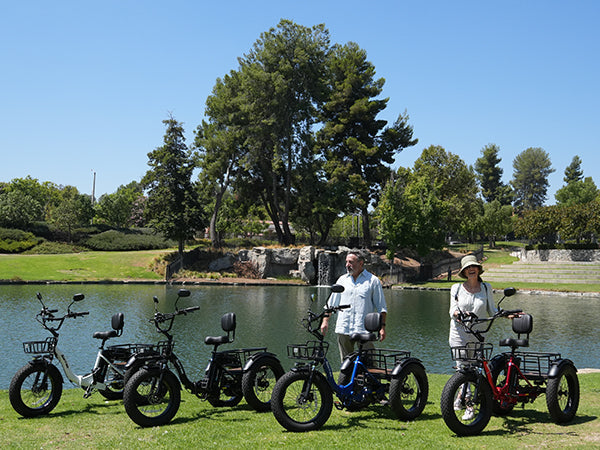
A rear hydraulic differential on an e-trike lets each rear wheel spin at different speeds through corners—cutting tire scrub, improving grip, and reducing tipping risk on tight turns. Most electric trikes use a fixed rear axle that drags the inside tire. Narrak's S180 and N8 include a true hydraulic differential at prices competitors with fixed axles can't match.
What Is a Rear Hydraulic Differential on an E-Trike?
A rear hydraulic differential is a fluid-coupled gearbox between the two rear wheels that allows them to rotate at different speeds—so the outside wheel can travel farther than the inside wheel through a turn without fighting the axle.
Every electric trike has two rear wheels driven by a motor. The critical design choice is how those wheels are linked:
- Fixed axle: Both rear wheels lock together and always spin at the same RPM
- Differential: Each rear wheel spins independently, with torque sent to the wheel that has more grip
Cars have used differentials for over a century. Yet most electric trikes—even models from Lectric, Rad Power, and Addmotor—still ship with fixed rear axles to cut manufacturing cost.
The Fixed Axle Problem: Tire Scrub and Cornering Drag
A fixed rear axle forces both tires to spin at identical speed through turns, causing the inside tire to scrub, drag, and lose grip—especially on tight park paths, driveway loops, and cracked pavement.
When you turn a trike, the outside rear wheel follows a longer arc than the inside wheel. On a fixed axle, both wheels must match RPM. The inside tire either skids (scrubbing rubber off the tread) or lifts slightly—reducing stability and increasing tipping risk on loaded turns.
What riders feel on a fixed-axle trike:
- Resistance when turning at low speed in parking lots
- Uneven tread wear on the inside rear tire
- A "pushing" sensation through tight corners
- Reduced confidence for seniors navigating park loops and cul-de-sacs
Hydraulic vs Mechanical Differential: What's the Difference?
Hydraulic differentials use fluid pressure to distribute torque smoothly between rear wheels—mechanical differentials use gears and clutch packs, which are heavier, noisier, and rare on e-trikes under $2,000.
| Type | How It Works | Pros | Cons |
|---|---|---|---|
| Fixed axle | Both wheels locked together | Cheapest to manufacture | Tire scrub, poor cornering, tipping risk |
| Mechanical differential | Gear sets allow speed difference | Proven in cars and trucks | Heavy, complex, rare on e-trikes |
| Hydraulic differential | Fluid coupling distributes torque | Smooth, quiet, compact | Higher manufacturing cost |
Narrak uses a hydraulic differential because it delivers car-like cornering feel in a compact package. The system automatically sends more torque to the wheel with more grip—useful on wet pavement, gravel, and uneven park paths.
How a Hydraulic Differential Improves Cornering and Reduces Tipping
You'll notice the difference on tight park loops, driveway turnarounds, and any route with repeated 90° corners—especially at 10–20 MPH with cargo loaded in the rear basket.
1. Smoother Cornering at Speed
The trike tracks through turns without the "pushing" sensation of a fixed axle. Both rear tires stay planted instead of fighting each other—seniors report more confidence on neighborhood loops and retirement-community paths.
2. Less Tire Wear
Even tread wear on both rear wheels extends tire life. Fixed-axle trikes often wear the inside rear tire 30–40% faster than the outside.
3. Better Grip on Mixed Surfaces
When one rear wheel hits gravel or a crack, the differential sends power to the wheel with traction. Combined with 20×4.0" fat tires on the S180 and N8, this improves stability on surfaces that challenge fixed-axle trikes.
4. Safer Turns with Cargo
A loaded rear basket shifts weight backward. A differential keeps both rear tires planted through turns instead of letting the inside tire lift—a meaningful safety improvement for riders hauling groceries or gear.
Fixed Axle vs Hydraulic Differential: Comparison Table
Hydraulic differentials win on cornering smoothness, tire wear, mixed-surface grip, and tipping resistance—fixed axles win only on manufacturing cost, which is why most brands skip the differential entirely.
| Factor | Fixed Rear Axle | Hydraulic Differential |
|---|---|---|
| Tight corner feel | Draggy, resistant | Smooth, natural |
| Tire wear | Uneven (inside tire faster) | Even across both wheels |
| Mixed-surface grip | One wheel spins, one drags | Power to gripping wheel |
| Loaded cargo turns | Inside tire lifts easier | Both tires stay planted |
| Tipping risk on tight turns | Higher with rear load | Lower |
| Senior confidence | Lower in tight spaces | Higher |
| Found on | Most budget & mid trikes | Narrak S180, N8 |
| Typical price point | $600–$1,800 | $1,180+ (Narrak) |
Narrak S180 and N8: E-Trikes with Hydraulic Differential
Both the S180 ($1,180) and N8 ($1,399) include a rear hydraulic differential—paired with hydraulic brakes, UL certification, and 1350W peak power no fixed-axle competitor matches at these prices.
Narrak S180 Folding Electric Tricycle
| Rear Axle | Hydraulic differential |
| Peak Motor | 1350W |
| Brakes | Hydraulic disc (front & rear) |
| Tires | 20" × 4.0" fat |
| Top Speed | 20 MPH |
| Foldable | Yes |
| Price | $1,180 |
The hydraulic differential folding trike that stays stable through tight turns at 20 MPH is the S180's defining feature. It folds for trunk storage, ships 90% pre-assembled, and includes front/rear baskets.
✔ Verdict: Best hydraulic differential e-trike for riders who want foldability, 1350W peak, and cornering stability under $1,200.
Shop S180 →Narrak N8 Semi-Recumbent Electric Trike
| Rear Axle | Hydraulic differential |
| Brakes | Triple hydraulic (front + dual rear) |
| Stability | Anti-tip wheels + semi-recumbent seat |
| Peak Motor | 1350W rear hub |
| Tires | 20" × 4.0" fat |
| Rider Capacity | 298 lbs (4'10" – 6'5") |
| Price | $1,399 |
The N8 pairs the hydraulic differential with triple hydraulic brakes and anti-tip rear wheels—the most complete cornering and stability package in Narrak's lineup. Ideal for seniors who ride daily on mixed-surface paths.
✔ Verdict: Best hydraulic differential trike for seniors who want anti-tip stability and triple hydraulic braking alongside differential cornering.
Shop N8 →FAQ: Hydraulic Differential on E-Trikes
Five technical questions riders ask about rear hydraulic differentials—covering function, cost, maintenance, competitor gaps, and whether the upgrade is worth it for seniors.
What is a rear hydraulic differential on an e-trike?
It is a fluid-coupled gearbox between the two rear wheels that lets each spin at different speeds through corners. This reduces tire scrub, improves grip on uneven surfaces, and makes turns smoother—especially at 10–20 MPH with cargo loaded.
Does a hydraulic differential reduce tipping on an e-trike?
Yes. By keeping both rear tires planted through turns—instead of letting the inside tire scrub or lift—a hydraulic differential reduces the sideways forces that cause tipping on tight corners, especially with a loaded rear basket.
Do Lectric or Rad Power electric trikes have a differential?
No. Lectric XP Trike2 models and the Rad Power RadTrike use fixed rear axles or front-hub drive without a rear differential. See our comparisons: N6 vs Lectric 500W and N8 vs RadTrike.
Is a hydraulic differential worth the extra cost?
Yes—especially for seniors and daily riders. Narrak includes it on the S180 at $1,180, which is actually cheaper than fixed-axle competitors like Lectric. You get the differential without paying a premium.
Conclusion
A rear hydraulic differential is the most underappreciated safety and comfort feature on electric trikes. It eliminates tire scrub, improves cornering grip, and keeps both rear wheels planted through turns—reducing tipping risk when cargo is loaded or surfaces are uneven.
Most brands skip it to save manufacturing cost. Narrak includes it on both the S180 ($1,180) and N8 ($1,399)—with hydraulic brakes, UL certification, and 1350W peak power that fixed-axle competitors can't match at these prices.
Free 3–5 day shipping from Los Angeles · 30-day returns · 1-year warranty · UL certified
Shop Hydraulic Differential Trikes →
Share:
Narrak N8 vs RadTrike: Which Adult E-Trike Wins?
Best Electric Trikes for Seniors 2026: Comfort & Safety