



Electric Cargo Trike vs Cargo E-Bike: Which Hauls Better?
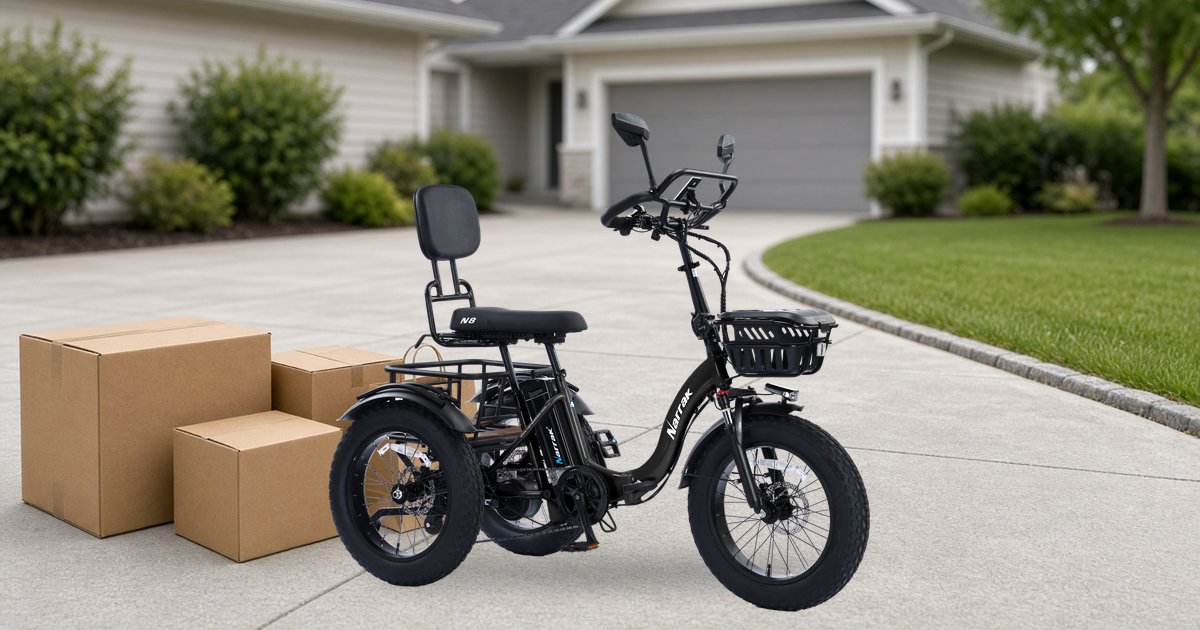
Choose an electric cargo trike when stop-and-go errands, balance confidence, and a planted rear rack matter more than weaving through bike lanes. Choose a cargo e-bike when you need a narrower footprint, higher cadence on two wheels, and you already trust tip control with a loaded bag. Narrak adult e-trikes (N8 comfort / S180 folding) keep rider-plus-cargo inside a published 350 lb limit, use walk-assist at about 1 mph (not reverse), and use a rear hydraulic differential for controlled slow turns—differences two-wheel cargo bikes do not share.
This page is a category comparison—cargo e-trike versus two-wheel cargo e-bike—not another brand-vs-brand scorecard. If you already know you want three wheels, use the cargo guide; if you are still choosing wheel count for hauling, start here.
60-Second Decision: Trike Cargo vs Bike Cargo
If your weekly job is short errands with bags that shift, a cargo trike usually wins on planted stops; if your job is longer mixed-speed rides on slim paths, a cargo e-bike usually wins on width and pace.
| Job | Electric cargo trike | Cargo e-bike (2-wheel) |
|---|---|---|
| Pharmacy / multi-stop neighborhood loops | Stronger—three-wheel base + parking hold while you dig for keys | Doable, but tip awareness rises when bags are uneven |
| Loaded slow turns in a lot | Hydraulic differential on Narrak helps the rears share the turn | Countersteer / lean skill required with high center of mass |
| Narrow bike-lane weaving | Wider footprint; plan path | Usually easier to filter and lean |
| Apartment / hatch storage | S180 folds; N8 needs floor space | Many cargo bikes fold or fit elevators better |
| Fear of tipping with paper bags / gear | Three-wheel confidence is the product | Requires practiced balance |
Stability & Slow Turns (The Real Split)
Cargo weight raises the center of mass; two wheels ask you to balance that mass, while a trike asks you to manage width and parking holds instead of tip angle.
Two-wheel cargo e-bikes shine when the rider already trusts low-speed balance with a front box or rear rack. The moment you stop on a crowned curb with a soft bag on one side, that balance job gets harder—especially for gift buyers shopping for a parent.
Adult e-trikes trade lane slimness for a planted stance. Narrak’s rear hydraulic differential is about controlled slow turns (not “never tip in every condition”). Pair that with a real parking brake ritual: full stop → set hold → prove zero creep. Walk-assist (~1 mph) is for crowd creep, not for backing out of a bad park—Narrak has no powered reverse, so approach angles matter.
Cargo Layout & 350 lb Math
Both categories haul; the difference is how load shares with the rider and whether the published weight limit stays honest when baskets are full.
Typical cargo e-bikes advertise a front crate, longtail deck, or panniers. Capacity numbers vary by brand; always separate rider limit from rack limit.
Narrak e-trikes publish a combined rider-plus-gear figure of 350 lb. Front basket + rear wood-slat rack are everyday tools—not an excuse to stack past the rating. For multi-stop bags, keep weight low and centered; side-heavy loads still tug a trike on camber even with three wheels.
| Check | Why it matters | Narrak note |
|---|---|---|
| Rider vs rack split | Marketing “cargo capacity” often ignores rider weight | Stay inside 350 lb combined |
| Stop with hands full | Parking hold beats “feet on the ground” | Practice hold before errand day |
| Slow turn with rear load | Inside rear wheel wants to scrub | Differential helps share the turn |
| Uneven bags | Creates lean / steer pull | Balance left/right; do not overload one rail |
Storage, Fold & Footprint
Cargo e-bikes usually win on slim storage; folding cargo trikes win when you need three-wheel confidence and a hatch-friendly frame.
If the deciding constraint is elevator width or a studio hallway, start with two-wheel cargo—then only move to a trike if balance anxiety outweighs width.
If the constraint is “I tip on two wheels when the weekly shop is loaded,” start with a trike. Narrak S180 (about $1,099) is the fold-first adult e-trike for trunk/RV/apartment staging; N8 (about $1,399) is the comfort/cargo-first stance when floor space is available and seat support matters more than fold.
Support, Specs & the Confidence Stack
Wattage charts look similar across marketplaces; ownership differences show up in UL clarity, returns, parts reachability, and whether slow-turn hardware is explained honestly.
Many cargo e-bikes compete on motor watts and crate photos. Narrak’s differentiation for everyday riders is a confidence stack: SoCal warehouse fulfillment narrative, UL on key models, 30-day returns, phoneable support, and the hydraulic differential story on e-trikes—not a race-bike pitch.
When you compare any cargo machine (trike or bike), verify: published weight limit, brake type, battery certification language, return window, and whether “walk mode” is sold as reverse (it should not be on Narrak).
Who Should Buy Which
Buy the cargo trike for planted errands and balance confidence; buy the cargo e-bike for slim paths and rider skill you already trust.
- Pick an electric cargo trike if: you want three-wheel confidence with bags, slow parking-lot turns, and a rear deck for weekly loops.
- Pick a cargo e-bike if: you already ride two wheels comfortably, need a narrower vehicle, and prioritize bike-lane pace over planted stops.
- Do not use this page for Lectric vs Rad vs Meet One—those brand matchups are separate Guides.
Where Narrak Cargo Trikes Sit
For hauling on three wheels without a brand roast: N8 for comfort seat + everyday rear cargo; S180 when fold/storage is part of the cargo plan. Both keep the 350 lb ceiling, ~1 mph walk-assist, no reverse, and differential-backed slow turns.
Verdict: If your real question was “will two wheels tip with groceries?”, decide stability first—then pick fold (S180) or comfort (N8).
Shop folding & adult e-trikesFAQ
Is an electric cargo trike safer than a cargo e-bike?
Can a cargo e-bike carry more than a trike?
Do Narrak trikes have reverse for tight parking?
S180 or N8 for cargo errands?
Is this the same as trike vs e-bike?
Why no separate grocery URL?
Conclusion
If loaded stops and tip anxiety drive the purchase, an electric cargo trike is the clearer tool; if slim paths and two-wheel skill already feel natural, a cargo e-bike stays competitive.
Narrak’s edge in this category comparison is not a louder wattage claim—it is the everyday confidence stack: differential-backed slow turns, honest walk-assist limits, 350 lb planning, and U.S.-reachable ownership. Pick S180 when fold is part of hauling; pick N8 when comfort cargo is the weekly job.
Ready to haul on three wheels with a clear weight limit and fold/comfort choice?
Shop adult e-trikes View N8 View S180
Share:
Electric Trike Parking Brake & Curbside Holds | Narrak