



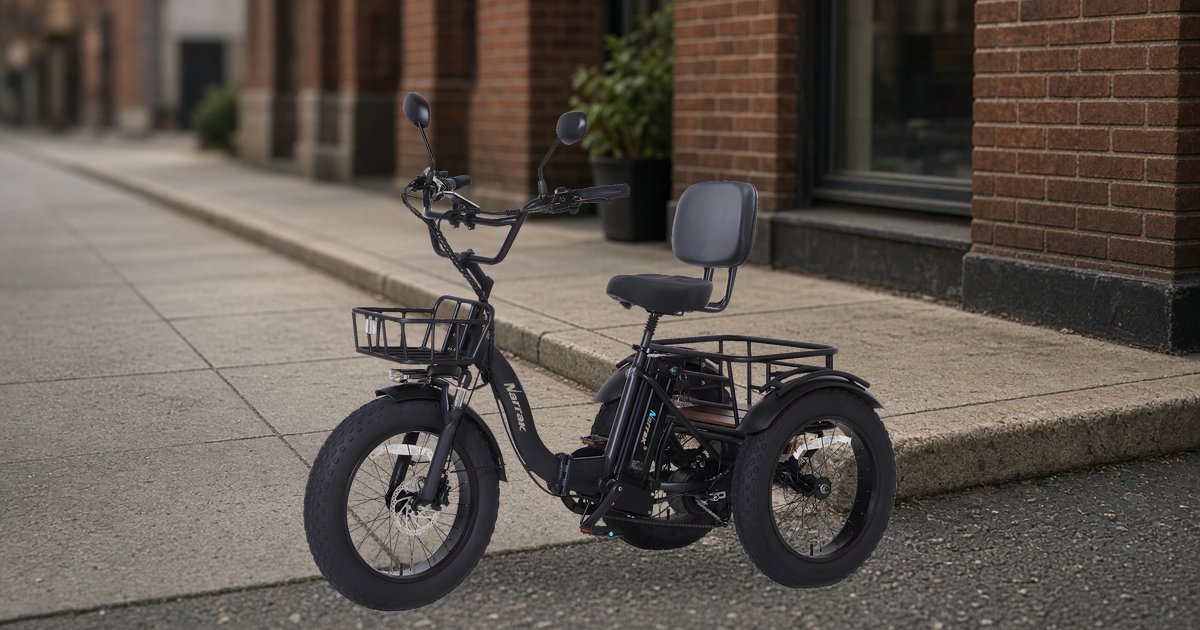
Electric Trike Parking Brake & Curbside Holds
If you are shopping or already riding an adult electric trike, the parking brake is the control that keeps the bike still while you stand up, dig for keys, or load a basket. Practice a full stop → set the hold → confirm zero creep on flat ground before you trust a crowned curb or a short driveway. Walk-assist (~1 mph) moves the trike slowly; it does not park it. Narrak models do not offer car-style reverse, so plan every curb so you can leave forward after you release the hold. Keep rider-plus-gear inside the published 350 lb capacity so the hold still feels honest when baskets are loaded.
Most people do not open a “parking brake” page because they love brake theory. They open it because they imagine the trike creeping into a crosswalk while both hands are full—or because a salesperson waved at “three wheels = safe” and skipped the hold ritual.
Why Curbside Holds Feel Risky on a Trike
Three wheels help tip resistance, but they do not cancel slope, soft shoulders, or a soft parking hold—rollaways start when the rider treats “stopped enough” as “parked.”
On a bicycle you often tip a pedal down and lean. On an adult e-trike you step off a wider footprint with a higher seat and, often, a basket that shifts weight. Storefronts are rarely flat: crown in the asphalt, driveway lips, and wheelchair ramps all pull the trike downhill the moment you look away.
If you are coming from a car, the missing piece is reverse. Narrak walk-assist is about 1 mph for controlled creep—not a reverse gear to back off a bad park. That is why approach angle matters as much as the lever itself.
What Buyers Actually Ask (Answer First)
Shoppers usually want three plain answers: will it stay put at a store, how do I practice without looking foolish, and which control is which—parking hold, walk-assist, or climbing power.
| Buyer question | Straight answer |
|---|---|
| Will it roll if I step off at the pharmacy? | Only if you skip a real parking hold. Full stop, set the hold, push the seat to prove zero creep, then leave the bars. |
| Is walk-assist a parking brake? | No. Walk-assist moves the trike ~1 mph. It will not pin the bike while you dig for a wallet. |
| Do I get reverse to fix a bad curb angle? | No powered reverse on Narrak. Approach so you can leave forward after release. |
| Does 350 lb capacity change holds? | Yes. Overload plus a side-heavy basket makes “fine for three seconds” into a curb-edge surprise. |
| Is fold latch play the same problem? | No. Latches are frame stability. Still set the parking brake for holds. |
Parking Brake vs Walk-Assist vs Hills
Use the parking brake to stay still, walk-assist to creep through crowds, and hill technique only while the wheels are already rolling—mixing those jobs is how soft holds and false confidence start.
| Job | Tool | Where to learn it |
|---|---|---|
| Stay stopped at a curb | Parking brake / hold | This page |
| Creep through a lobby or crowded sidewalk | Walk-assist ≈1 mph | Walk-assist guide |
| Climb while still rolling | PAS + gearing habits | Hills guide |
Hardware context: S180 hydraulic brake system (stopping hardware—not a substitute for the parking-hold drill below).
Flat Curb Drill You Can Rehearse Tonight
Rehearse on empty flat pavement until the ritual is boring: stop completely, set the hold, prove zero creep, then release only when both hands are back on the controls.
- Pick a quiet lot. No audience, no bags, no phone in hand.
- Roll to a full stop. Do not reach for anything while the wheels still creep.
- Set the parking brake / hold the way the model’s manual describes for your lever or latch style.
- Proof test: stand beside the seat and give a firm, honest push. If it moves, reset. A foot on the ground is a backup, not the plan.
- Count to ten with hands free. That is the storefront moment you are training for.
- Remount, release, roll forward. Practice the exit you will use when reverse is not an option.
Only after flat drills feel automatic should you add mild camber—the gentle crown you will meet outside real shops.
Folding riders on the S180: confirm fold latches are locked before baskets go on. Latch play is not a parking brake.
Driveways, Ramps & Camber
On short slopes, aim the wheel line so the hold fights the downhill vector, and never use walk-assist as a fake brake while you are off the seat.
- Face the grade. Side-on parking on a driveway ramp is a common rollaway setup.
- Leave a forward exit. If the only way out is backward, you chose a bad approach.
- Skip “creep-brake.” Walk-assist is for motion through people, not for pinning a bike on a slope while you shop.
- Respect capacity. S180 and N8 publish up to 350 lb rider capacity—leave margin when baskets are full.
Long climbing while rolling still belongs on the hills guide. This section is only the pause.
Loaded Baskets & Side Bias
Bags change how a hold feels: center the weight, strap before you walk away, and finish the parking brake before you restage—departure is when most rollaways start.
- Soft bags under hard boxes so nothing avalanches when you remount.
- If one stop adds a heavy bag, recenter before unlock.
- Passenger or pet weight still counts toward published capacity; baskets are not “free.”
- For a full pharmacy → post → market afternoon, use the errands circuit; this page owns the hold at each curb.
What to Check Before You Buy (Or Before Market Day)
Before money or before a busy Saturday, confirm you can demonstrate a zero-creep hold on flat ground and that you accept no powered reverse at awkward curbs.
- Can you set and release the hold without looking down for ten seconds?
- Does a seat push prove zero creep with a normal basket load?
- Is your first real curb one you can leave forward?
- If storage is the bottleneck, start in the folding electric trike collection and rehearse holds on the machine you will actually own.
Fold-first daily riders + honest curb holds
Browse folding models when hatch or elevator space is the constraint, then run the flat drill before the first errands day. The S180 is the usual fold-first starting point—confirm live capacity and brake details on the product page.
Verdict: buy the machine you will rehearse on, not a brochure hold you never drill.
Shop folding electric trikesRollaway Mistakes (Fix These First)
Most rollaways come from the wrong tool or a skipped proof test—not from “three wheels being unstable.”
- Using walk-assist as a hold while hunting for keys
- Expecting reverse to erase a bad curb angle
- Parking on a soft shoulder with bags stacked downhill
- Skipping the seat-push proof because “it looks stopped”
- Releasing the brake with one hand still in a shopping bag
- Treating fold latches as optional after an elevator fold
FAQ: Electric Trike Parking Brake
Is an electric trike parking brake the same as walk-assist?
No. Walk-assist is slow motion at about 1 mph. A parking brake keeps the trike still at curbs and short slopes.
How do I know my parking hold is actually working?
After a full stop, set the hold and push the seat firmly. Any creep means reset before you walk away.
Do Narrak electric trikes have powered reverse?
No. Plan curb approaches so you can leave forward after you release the parking brake.
Does rider capacity affect parking holds?
Yes. Stay within published capacity (S180 and N8: up to 350 lb) and avoid side-heavy baskets on camber.
Should I practice before my first storefront stop?
Yes. Run the flat curb drill in an empty lot until it is boring, then add mild camber.
Is fold-latch play a parking brake problem?
No. Latch play is frame stability. Still set the parking brake for holds.
Conclusion
A useful parking brake page answers the storefront fear with a drill you can prove—full stop, set hold, seat push, forward exit—not with a slogan about three wheels.
When storage is tight, start in the folding electric trike collection and rehearse on the trike you will keep.
Ready for a daily adult trike with a hold you can rehearse?
Browse folding electric trikes View S180
Share:
Electric Trike Day Picnic & Camping Loops: Packing & Trailhead Ops | Narrak