




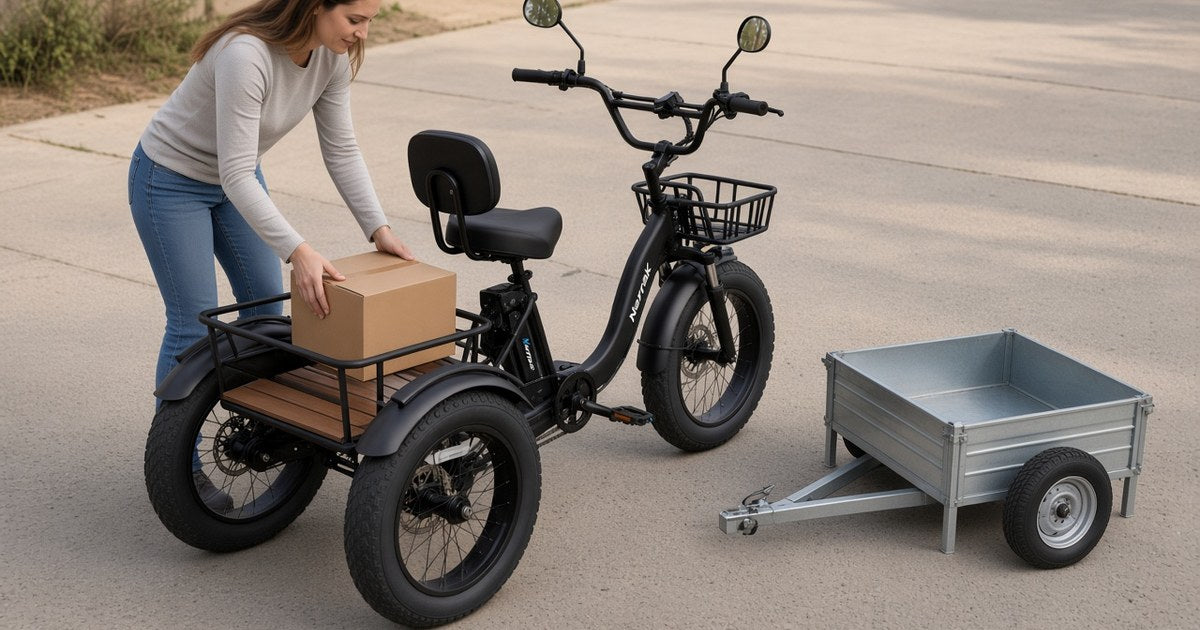
Electric Trike Trailer Guide: Rack vs Hitch
An electric trike trailer is worth it when weekly bulk cargo outgrows a rear rack—not when you only carry two totes. Keep rider-plus-gear inside the published 350 lb capacity, treat walk-assist (~1 mph) as creep only, and remember Narrak models have no reverse for trailer docking. Most shoppers should master rear-rack loading on S180 ($1,099) or N8 ($1,399) before buying hitch hardware.
Trailer pages get clicks from people who imagine one big haul—then discover their real week is three pharmacy stops and a laundry tote.
When an Electric Trike Trailer Beats a Rear Rack
Choose a trailer for repeated bulk volume; choose a rear rack for daily errands where hitching time costs more than capacity gained.
| Job | Better tool | Why |
|---|---|---|
| 2–4 tote errands | Rear rack / basket | Faster; stays inside capacity easier |
| Weekly garden-center bulk | Trailer | Volume wins if hitch ritual is practiced |
| Lobby / elevator buildings | Rack (or fold S180) | Trailers fight doors and turns |
| Soft shoulder / curb holds | Rack first | Less side bias while you set the parking hold |
350 lb Split: Rider, Rack, Trailer
Capacity is a budget: weigh yourself, then subtract baskets and trailer tongue effects before you celebrate “more space.”
- Write rider weight + helmet/bag
- Add planned rack load
- If hitching, leave extra margin—do not treat trailer volume as free mass
- Stop adding when you approach the published 350 lb ceiling
Hitch, Turning & Parking Holds with a Trailer
Practice empty hitching, wider turns, and a seat-push parking hold before you load—walk-assist will not rescue a bad angle.
- Full stop → set parking hold → prove zero creep before loading
- Walk-assist ≈1 mph for creep only
- No powered reverse—approach so you leave forward
- Watch rear swing in parking lots
Narrak context for trailer-curious shoppers
Use N8 when comfort + rack covers most weeks. Use S180 when the trike itself must fold after cargo days. Add a trailer only after rack weeks feel genuinely volume-limited.
Verdict: rack-first; trailer as a planned upgrade—not day-one kit.
Shop folding electric trikesWhen to Skip the Electric Trike Trailer
Skip the trailer if hitching would make you avoid short rides, or if elevator and curb geometry already feel tight with the trike alone.
FAQ
Do I need an electric trike trailer for groceries?
Often no. A rear rack plus honest 350 lb split covers pharmacy and tote loops. Add a trailer only when volume repeats weekly and you have a hitch plan.
Can a trailer exceed the trike capacity?
No. Rider + cargo on the trike + tongue/load effects still must respect the published capacity—commonly up to 350 lb on Narrak adult models.
Trailer vs rear rack on Narrak S180 / N8?
Rear rack wins most errand days. Trailer wins bulk garden-center or market runs when you accept hitching and wider turning.
Does walk-assist pull a loaded trailer?
Walk-assist is ~1 mph for creep. It is not a substitute for parking holds or for dragging overloaded trailers up ramps.
Is reverse available to back a trailer into a stall?
Narrak does not offer car-style reverse. Plan approaches so you leave forward after releasing the hold.
Which model if I mostly use a rack, not a trailer?
Either S180 or N8 works with racks; pick S180 for fold storage, N8 for comfort-first pads.
Conclusion
An electric trike trailer pays off only after rear-rack capacity and 350 lb math are honest—and only if you accept no-reverse docking discipline.
Share:
3 Wheel Electric Bike for Seniors | Narrak