



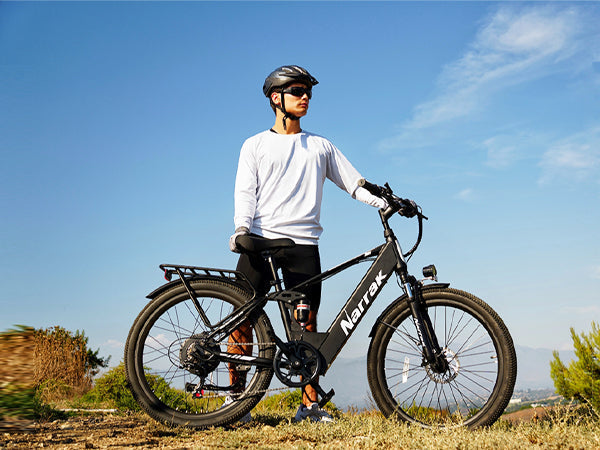
A dual motor ebike runs two hub motors—one front, one rear—for stronger hill climbing and off-road traction. For most US riders in 2026, dual drive is worth it if you face steep grades, loose terrain, or carry extra weight; otherwise a single motor saves range and money. This guide compares specs, real trade-offs, and our top picks so you can decide before you buy.
Best two-wheel dual motor: Narrak N8 — 1350W peak, 20×4.0" fat tires, $1,399.
Best dual motor trike: Narrak S180 — same peak power, hydraulic differential, folds flat, $1,180.
Skip dual motor if: your route is flat pavement only—Narrak M3 at $669 is lighter and goes farther per charge.
What Is a Dual Motor Ebike?
In short: A dual motor ebike has separate electric motors in the front and rear hubs, working together for more torque, faster starts, and better grip on hills and loose surfaces.
Unlike a single-motor setup, dual drive splits the workload. The front motor pulls through sand and gravel; the rear motor pushes with most of your body weight behind it. On a steep climb, both motors engage so you feel less strain and more control.
- Front hub motor — adds pulling force and front-wheel traction.
- Rear hub motor — delivers push power where weight naturally sits.
- Dual engagement — both motors run on hills, throttle starts, and off-road sections.
Important: two motors do not change your legal class. Most dual motor ebikes sold in the US are still Class 2 (20 MPH with throttle) or Class 3 (28 MPH pedal-assist). Check local trail and bike-path rules before riding with throttle.
Single Motor vs Dual Motor: Which Is Better?
In short: Choose dual motor for hills, off-road, and riders over 220 lbs; choose single motor for flat commutes, lighter weight, and longer range on the same battery.
Dual motor is not automatically "better." It is better for harder conditions. The table below is the fastest way to match drive type to how you actually ride.
| Factor | Single Motor | Dual Motor |
|---|---|---|
| Hill climbing (10°+) | Works on mild grades | Noticeably stronger |
| Sand / gravel / trails | Moderate grip | Front + rear traction |
| Typical bike weight | 45–55 lbs | 55–75 lbs |
| Range (same battery) | Longer | ~10–20% shorter |
| Typical price | $600–$1,000 | $900–$2,000 |
| Best use case | City commutes, flat paths | Hills, off-road, cargo, 220+ lb riders |
What Should You Look for in a Dual Motor Ebike?
In short: Prioritize verified peak wattage (1,000W+), a 48V 13Ah+ battery, hydraulic or dual-disc brakes, fat tires for off-road, and UL 2849 full-bike certification.
Many listings hide weak motors behind marketing terms. Use this five-point checklist before you add anything to cart.
1. Peak Wattage — Not Just "750W Rated"
Rated power is the legal label; peak power is what you feel on a hill. Look for 1,000W+ peak. Narrak N8 and S180 list 750W rated with 1350W peak through a transmission boost—enough to climb 20° grades with a loaded rider.
2. Battery: 48V 13Ah (624Wh) Minimum
Two motors draw more current. Under 624Wh, expect frequent charging on hilly routes. Confirm UL 2271 battery certification for US safety compliance.
3. Brakes That Match the Power
More torque and more weight demand better stopping. Hydraulic disc brakes (standard on S180) or mechanical dual-disc with motor cutoff are baseline requirements for off-road dual motor riding.
4. Tire Width for Traction
Dual drive only pays off if tires can use the extra grip. For trails and sand, 20×4.0" fat tires outperform narrow 26×2.4" commuter tires on the same motor setup.
5. UL 2849 Full-Bike Certification
UL 2849 covers the complete assembled ebike—not just the battery. It matters more on high-output dual motor bikes you plan to push on steep terrain.
Best Dual Motor Ebikes in 2026: Comparison Table
In short: The Narrak N8 leads for two-wheel off-road power at $1,399; the S180 wins on stability and cargo at $1,180—both hit 1350W peak, above the ~1000W market average.
| Model | Peak Power | Top Speed | Tires | Range | Capacity | Price |
|---|---|---|---|---|---|---|
| Narrak N8 ★ Pick | 1350W | 20 MPH | 20×4.0" fat | ~50 mi | 298 lbs | $1,399 |
| Narrak S180 ★ Pick | 1350W | 20 MPH | 20×4.0" fat | ~50 mi | 290 lbs | $1,180 |
| Typical competitor | ~1000W | 20 MPH | 26×2.4" | ~35 mi | 250 lbs | $900+ |
Narrak N8 vs S180: Which Dual Motor Model Fits You?
In short: Pick the N8 for two-wheel trail agility and maximum off-road torque; pick the S180 for three-wheel stability, folding storage, and built-in front/rear cargo baskets.
Narrak N8 — $1,399
The 1350W dual-motor fat-tire bike climbs 20° grades and handles sand, gravel, and cracked pavement without giving up two-wheel maneuverability. 5.0★ rated. UL 2849 + UL 2271.
Choose N8 if: you want maximum off-road torque in a standard bike footprint.
Shop N8 →Narrak S180 — $1,180
The folding trike with hydraulic differential keeps 1350W peak power stable through corners—plus front and rear baskets no two-wheeler matches. 4.9★ (44 reviews).
Choose S180 if: balance, cargo, and fold-flat storage matter more than trail agility.
Shop S180 →Not sure which power level you need? Browse every Narrak high-torque model built for hills and off-road riding—specs, reviews, and current pricing in one place.
When Should You Skip a Dual Motor Ebike?
In short: Skip dual motor if you only ride flat pavement, need a bike under 50 lbs, or have a budget under $700—a quality single-motor ebike will be lighter, cheaper, and more efficient.
- Flat-only commutes — single motor saves 15–20 lbs and $300–$600.
- Stairs / transit portability — dual motor bikes typically weigh 55–75 lbs.
- Budget under $700 — reliable dual motor starts around $900; below that, specs are often inflated.
- No peak wattage or UL listing — likely underpowered or uncertified; walk away.
Watch for misleading labels: one 1,000W motor marketed as "dual power" is not a true dual hub setup. Confirm two separate hub motors in the spec sheet.
Frequently Asked Questions About Dual Motor Ebikes
In short: Dual motor ebikes are legal in the US when they meet Class 1/2/3 limits, top out at 20–28 MPH depending on class, and trade some range for hill-climbing torque.
What does "dual motor ebike" mean?
It means the bike has two electric hub motors—usually one in the front wheel and one in the rear. They work together to deliver more torque for hill climbing, quicker acceleration, and better traction on loose or uneven terrain than a single-motor bike.
Are dual motor electric bikes legal in the United States?
Yes. Dual motors do not create a separate vehicle class. As long as the bike meets Class 1, 2, or 3 speed and power limits—and you follow local trail and sidewalk rules—it is treated like any other compliant ebike. Narrak models carry UL 2849 full-bike certification.
How fast can a dual motor ebike go?
Most Class 2 dual motor ebikes cap at 20 MPH with throttle assist. Class 3 models reach 28 MPH with pedal assist only. Extra motors add torque for climbing—they do not automatically mean higher top speed.
Does dual motor drain the battery faster?
Generally yes. Running both motors on steep hills or heavy throttle pulls more current, so expect roughly 10–20% less range than a single-motor bike with the same battery capacity. Flat-road cruising with light assist narrows that gap.
What is the best dual motor ebike under $1,500 in 2026?
For two-wheel riders, the Narrak N8 at $1,399 offers 1350W peak power, 20×4.0" fat tires, ~50-mile range, and full UL certification—the strongest value under $1,500 we've compared. For three-wheel stability at a lower price, the S180 at $1,180 matches peak power with a folding frame and cargo baskets.
Is a dual motor ebike worth the extra money?
Worth it if your daily ride includes steep hills, unpaved paths, or you regularly carry cargo or ride above 220 lbs. Not worth it for flat city commutes—a single-motor model like the Narrak M3 costs less, weighs less, and stretches your battery further.
Can I ride a dual motor ebike in the rain?
Narrak dual motor models are IPX5 rated, so light rain and wet roads are fine. Avoid riding through deep puddles or storing a wet bike without drying the battery compartment. Never submerge motors or the battery pack.
Bottom Line: Should You Buy a Dual Motor Ebike?
In short: Buy dual motor when terrain or weight demands extra torque; buy single motor when efficiency and portability matter more.
Match the drive system to your real riding conditions—not the spec sheet. Hills, sand, and heavy loads reward dual drive. Flat pavement rewards a lighter single-motor bike.
For two-wheel off-road power, the Narrak N8 at 1350W peak is our 2026 top pick. For stability, cargo, and a fold-flat frame, the S180 trike at $1,180 delivers the same peak output with three-wheel confidence.
Share:
Folding Electric Trike Guide: Stability and Power